2 Aug 2026
Decision-Making Behaviors in Browser-Based Hybrid Action Puzzle Strategy Games
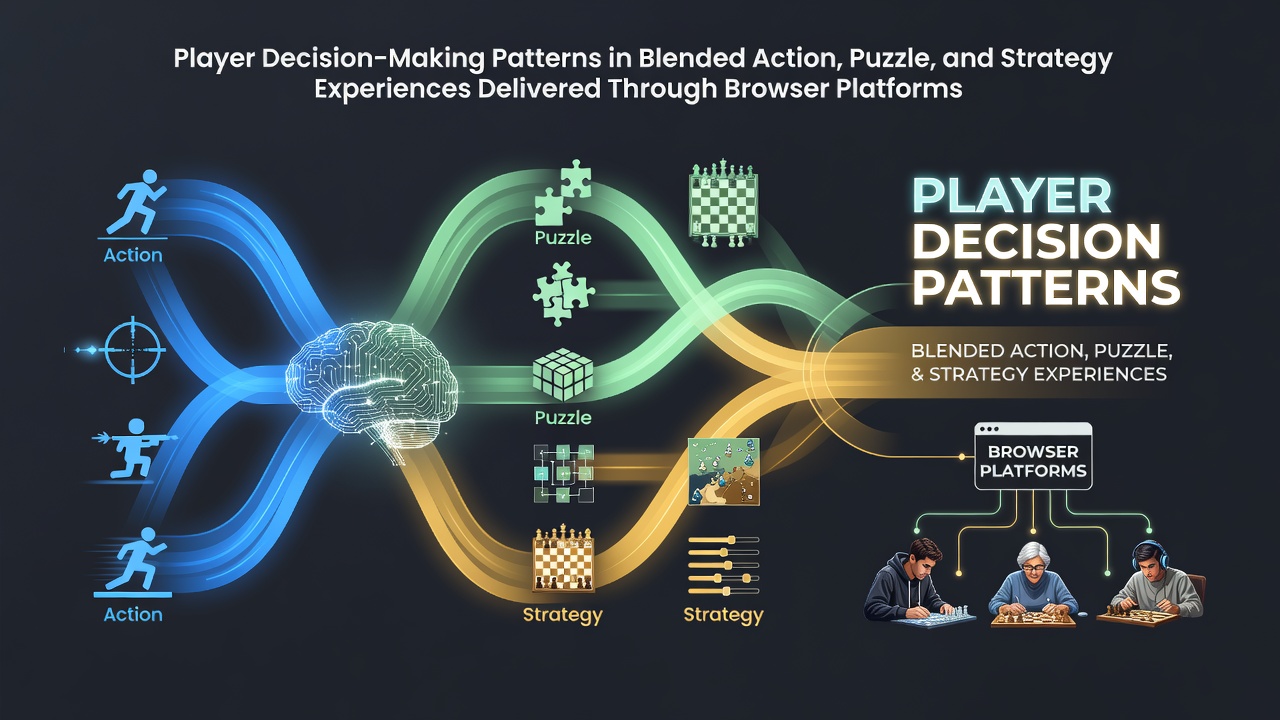
Browser platforms continue to host games that merge rapid action sequences with puzzle solving and long-term strategy layers, creating environments where players shift between immediate responses and calculated planning within single sessions. Researchers tracking user interactions note distinct patterns emerging when these elements combine, as individuals must allocate attention across time-sensitive inputs and analytical assessments simultaneously. Data collected through platform analytics in August 2026 shows average session lengths extending beyond traditional single-genre titles because participants revisit choice points multiple times before committing to paths that affect later stages.
Cognitive Shifts During Blended Play Sessions
Studies from academic institutions indicate that players alternate between heuristic shortcuts during action bursts and systematic evaluation when puzzle knots appear, while strategy components demand projection of future states across multiple turns. Those who have examined telemetry logs find that decision latency increases at transition points where an action segment ends and a puzzle interface loads, suggesting a mental reset occurs before engagement resumes. Evidence from aggregated user data reveals that experienced participants reduce this latency over repeated exposures, developing automated transitions that preserve momentum across genre boundaries.
Patterns Observed in Action-Puzzle Integration
Action segments require split-second selections based on visual cues and motor timing, whereas puzzle sections introduce constraints that reward exhaustive search within limited rule sets. Observers note that successful players often carry forward spatial awareness gained from action phases into puzzle navigation, applying movement habits to manipulate elements more efficiently. Figures released by industry groups such as the Entertainment Software Association highlight how browser delivery enables seamless switching without download interruptions, allowing decision sequences to unfold continuously and produce measurable improvements in cross-task performance.
One analysis of browser session recordings demonstrated that participants who pause briefly before puzzle initiation achieve higher completion rates on combined levels compared with those who proceed without interruption. This pause correlates with retrieval of strategy objectives established earlier, illustrating how prior commitments shape immediate puzzle tactics. Data indicates such integration strengthens when browser interfaces maintain consistent control mappings across all three genres.

Strategic Layer Influence on Earlier Choices
Strategy frameworks in these titles typically involve resource allocation and territory control that retroactively affect action and puzzle outcomes. Research indicates players who prioritize long-term positioning during strategy phases exhibit different risk thresholds when returning to action segments, opting for conservative maneuvers that preserve accumulated advantages. Reports from the Canada Media Fund document similar patterns in browser-accessible titles, where decision trees branch based on earlier resource investments and produce measurable divergence in completion statistics across player cohorts.
Those monitoring progression metrics find that puzzle difficulty spikes prompt reevaluation of strategy reserves, leading some participants to backtrack through action sequences to gather additional assets before attempting the next challenge. This backtracking behavior appears more frequently in browser environments because session persistence allows players to resume exactly where they paused without reloading full client states.
Measurement Approaches and Data Trends
Platform operators employ heat-mapping of input clusters and decision timestamps to quantify how players distribute cognitive effort across genres. Results compiled through August 2026 show elevated activity around strategic branching nodes that connect to both action and puzzle sub-routines. Analysts observe that browser-based delivery reduces friction in testing alternative paths, encouraging wider exploration of decision spaces within single playthroughs compared with downloadable counterparts.
Patterns also emerge around social features embedded in browser strategy layers, where shared objectives alter individual risk calculations during action and puzzle segments. Participants coordinating with others demonstrate adjusted timing on critical choices, deferring immediate puzzle solutions until group consensus forms on strategic priorities.
Conclusion
Browser platforms facilitate repeated observation of decision-making patterns as players navigate blended action, puzzle, and strategy experiences. Aggregated telemetry continues to reveal how transitions between genres shape subsequent selections, with strategy considerations exerting backward influence on earlier action and puzzle responses. Ongoing collection of session data supports further mapping of these interconnected choice structures across evolving browser titles.