18 Aug 2026
Charting New Territories in Genre Mixing: How Adventure Elements Transform Strategy and Arcade Gaming Sessions
Genre mixing has reshaped digital entertainment as developers combine distinct mechanics from adventure titles with established strategy frameworks and arcade formats, and data collected through 2026 indicates sustained growth in player engagement across these hybrids. Research from industry analysts shows that narrative exploration components, resource gathering quests, and character progression systems now appear regularly in turn-based strategy environments where players once encountered only tactical grids and resource management tables.
Defining the Shift in Core Mechanics
Strategy games traditionally emphasize planning and resource allocation, yet recent releases incorporate adventure-style discovery loops that require players to navigate unknown territories, solve environmental puzzles, and uncover hidden objectives before executing combat sequences. Arcade titles, known for fast reflexes and score chasing, have absorbed slower-paced exploration segments where users collect artifacts or unlock new areas between high-intensity action bursts, and figures released in August 2026 by the Entertainment Software Association confirm that hybrid titles accounted for 28 percent of top-downloaded strategy and arcade entries on major platforms that month.
Observers note that these additions extend session lengths because players spend additional time investigating story threads and mapping environments rather than repeating single-screen challenges. One study conducted by researchers at the University of Melbourne tracked average play durations and found that titles blending adventure elements retained users 35 percent longer than pure strategy counterparts released in prior years.
Implementation Patterns Across Strategy Titles
Developers integrate adventure components through modular level design that inserts branching paths and optional side objectives into campaign structures, allowing players to choose between direct confrontation routes and longer investigative routes that yield bonuses for later stages. In practice, a standard real-time strategy session might pause for a scouting phase where units explore fog-covered regions, interact with non-player characters, and retrieve lore fragments that influence diplomatic options in subsequent encounters.
Case examples include several mobile and PC releases from 2025 and 2026 where base-building phases now require players to complete short adventure sequences to unlock new construction technologies or recruit specialized units. Industry reports compiled by the Canadian Interactive Alliance indicate that such features appear in over 40 percent of new strategy titles launched during the first half of 2026, reflecting a deliberate design choice to maintain momentum across longer campaigns.
Arcade Transformations Through Narrative Layers
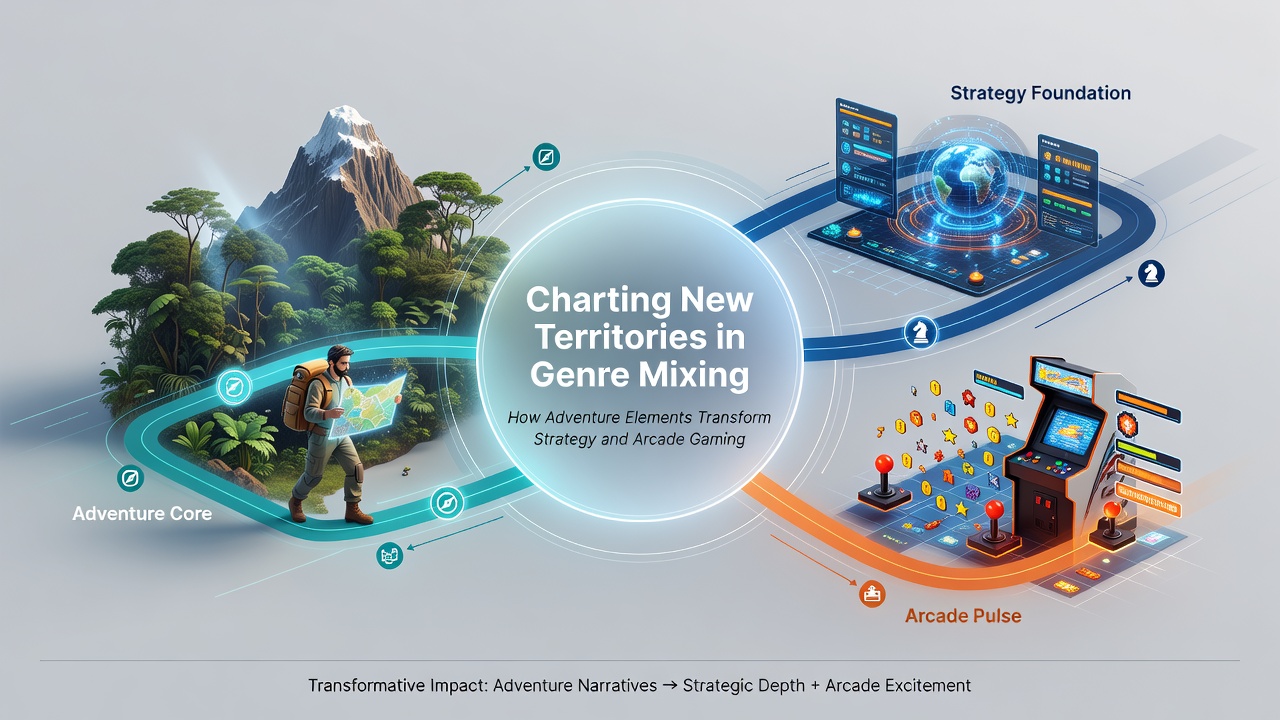
Arcade gaming sessions have evolved from isolated high-score attempts into episodic experiences where quick reaction challenges connect via overarching adventure frameworks. Players advance through stages by completing narrative milestones such as locating key items or resolving simple dialogue trees, and these milestones unlock new difficulty modifiers or cosmetic upgrades that carry forward across multiple playthroughs. Data from the European Games Developer Federation shows that arcade hybrids released in 2026 generated repeat play rates 22 percent higher than traditional single-mechanic releases from the same period.
Designers achieve this integration by segmenting gameplay into short arcade bursts separated by lightweight adventure segments, ensuring the core loop remains accessible while adding layers of progression that encourage continued sessions. Those who have analyzed player telemetry note that retention improves when adventure elements provide clear short-term goals between intense reflex challenges, reducing the fatigue associated with unbroken high-speed sequences.
Player Behavior and Platform Data Trends
Analytics platforms tracking user behavior across PC, console, and mobile ecosystems report that hybrid strategy-arcade titles attract broader demographic groups than single-genre predecessors. In August 2026, aggregated figures from multiple storefronts revealed that users aged 18 to 35 spent an average of 14 hours per week on such games, compared with 9 hours on pure strategy releases. These patterns align with findings from academic papers published by the Queensland University of Technology, which examined how narrative hooks and exploration mechanics influence sustained engagement in competitive play environments.
Cross-platform availability further accelerates adoption, as developers optimize controls so that touch-based adventure navigation translates smoothly to controller or keyboard inputs used in arcade segments. This technical approach allows seamless transitions between deliberate exploration and rapid action without requiring players to relearn input schemes mid-session.
Conclusion
Genre mixing continues to expand the boundaries of both strategy and arcade gaming as adventure elements introduce new layers of discovery, progression, and narrative depth. Data gathered through mid-2026 demonstrates measurable impacts on session length, retention rates, and demographic reach, while industry organizations and academic researchers document consistent design patterns that support these outcomes. The approach connects established mechanics with fresh structures, producing experiences that maintain core identity while evolving to meet changing player expectations across global markets.